
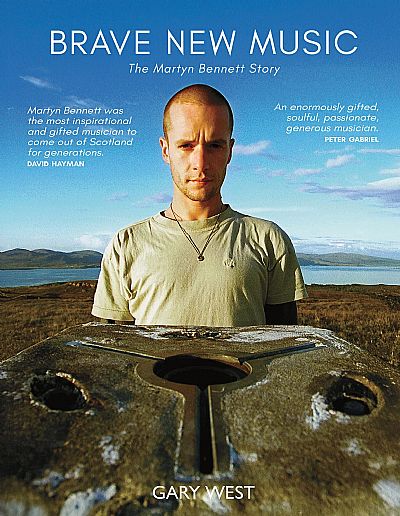
Gary West: Brave New Music – The Martyn Bennett Story (Luath Press, 352pp)
He was the piper who caused a sensation at Glasgow Jazz Festival. But then, Martyn Bennett’s musicality drew attention wherever he played, whether that be busking on Sauchiehall Street or performing on Millennium Night on Edinburgh Castle esplanade or at Cambridge Folk Festival.
Bennett had a natural aptitude for music, a talent that was guided by expert tuition. Yet the music that is his legacy was compiled largely on a computer. The last of his five albums, Grit, was the triumph of a man who had smashed his instruments in a fit of frustration at no longer being able to play to his own exacting standards. He became “the singer” painstakingly bringing together sounds and songs sampled from the tradition he grew up in and fusing them with the dance beats he had fallen in love with while a student at what is now the Royal Conservatoire of Scotland.
His life was short. He died aged thirty-three in January 2005 and the last years of his life were marked by extensive chemotherapy, radiotherapy, a bone marrow transplant and a splenectomy. Yet he persevered with music, revising, editing, adding to and perfecting (although he never felt he’d achieved perfection) his final work.
Gary West is a piper himself – he also presented the specialist piping programme, Pipeline, for BBC Radio Scotland for two decades – and is well placed to tell Bennett’s story. He knew Bennett and in writing this very readable account, he must have had to hold material in reserve because everyone who met Bennett has a Martyn story.
Bennett was born in Newfoundland but came to live in the Highlands, in Kingussie, aged five, with his mother, Margaret, when her marriage to Bennett’s father, Welsh geologist Ian Knight, ended. Perhaps because Margaret Bennett is such a valued presence in Scotland as a folklorist and singer, Bennett’s father has often seemed to be a shadowy figure until now. West has ensured that he is very much part of his son’s story and shows that the music gene came from both sides of the family.
Attending folk festivals with his mother, the young Martyn was exposed to the singers and characters who fed into his own grasp of the tradition, and when he gravitated to the pipes – via the practice chanter that he apparently mastered in record time – he became quite the junior phenomenon.
Winning a place at Broughton High School’s specialist music unit in Edinburgh by auditioning on the pipes led to classical training in violin, piano and composition. He might have become an international soloist on violin – he “depped” with the exacting Edinburgh Quartet on several occasions – but classical music wasn’t in his blood. The pipes, traditional songs and club beats were.
And so began an adventure that involved a classic television commercial for Drambuie, with Bennett playing an extraordinary fluent reel on the smallpipes as Robert Hardy’s butler delivers a specially flown in bottle of the liqueur – then drops it. It also included some heroically chaotic international touring, a frenetic session in Paris during the 1998 World Cup that saw Sean Connery and Ewan McGregor cavorting onstage, and a duo with drummer Tom Bancroft that showcased Bennett’s improvisational capabilities. There is also the appreciation that Peter Gabriel and his record label, Real World, showed for Bennett’s work and the reaction to it from Hamish Henderson, the father of Scotland's folk revival, that gives the book its title.
Gary West marshals all this – and more – as well as informed assessments of Bennett’s recordings with considerable skill. There is much about Bennett’s later years that is tragic, but Bennett himself was quite the mischievous sprite, full of humour, and what comes through above all is his determination to present the music he heard in his imagination to the very best standards.
These days the music Bennett created through his combination of alchemy, musical brilliance and computer technology is largely presented by the Grit Orchestra, an eighty-strong ensemble of traditional, classical and jazz musicians. They fill large auditoriums, including Glasgow’s 13,000 capacity Hydro, with music whose details are still revealing themselves, possibly even to the man, violinist Greg Lawson, who has orchestrated and conducts this ambitious celebration of Bennett’s work. Lawson actually predicted that he would orchestrate Bennett’s blend of tradition and electronica and delights in sharing Bennett’s poker-faced response when told this: “Are ye, now?”

Rachel Walker & Aaron Jones, Despite the Wind and Rain (Ròs Dearg Records)
Despite the Wind and Rain is the first album from the duo of Gaelic singer-pianist Rachel Walker and singer and multi-instrumentalist Aaron Jones.
Both prominent on the Scottish traditional music scene over the past twenty years – Walker with Gaelic singing group Cruinn and West Coast band Skipinnish; Jones with North-east ballad champions Old Blind Dogs – they pay tribute here to influential but under-recognised women in Scottish history.
It's a well-researched project and easy on the ear, with Walker and Jones’ own writing, singing and instrumental talents complemented by Gaelic poet Marcas Mac an Tuairneir and some of Scotland’s leading string and session players.
Walker celebrates the fourteenth century warrior queen Sgàthach in a slightly ethereal opening track and sings of Gormshuil Mhòr’s wisdom to choppy, effective string rhythms. Jones remembers Glasgow-born curator of Ghana’s heritage, Maud Sulter with a sturdy vocal, honours the suffrage movement in the plaintive Sunflowers and details the delightful Orcadian character Bessie Miller in a manner that’s not a million miles away from Paul Brady’s classic Arthur McBride.
From Songlines, March 2023
Celtic Connections, Phil Cunningham: Beyond the Farther Shore with Session A9, Glasgow Royal Concert Hall
Monday night as Celtic Connections was the night of the tunesmith. You might argue, reasonably, that every night at this festival features melodists. Here, though, it just seemed more pronounced.
Opening band, Session A9 have as their central attraction a quartet of fiddlers, all of whom have written tunes that have passed into the tradition through popular use. Playing with zest, exuberance, finesse, a finely honed harmonic sensitivity and an element of cheek and mischief, the fiddlers and their crisp, rollicking rhythm section of keyboard, guitar and percussion produced a thoroughly enjoyable set.
Twice they also visited the works of another tunesmith, the late piping genius Gordon Duncan, delivering his Jig of Beer with a kind of thirsty relish and dropping down several gears to treat The Sleeping Tune with care, attention and superb musicality.
If, as is apparently the case, Phil Cunningham can compose an enduring melody on a napkin so that the right to name it can be auctioned at that same dinner, you can imagine what the features off the coasts of Scotland and Ireland can inspire.
Written for the BBC TV documentary The Narrow Sea The Farther Shore, his tunes here variously exhibited gentle restraint, cinematic grandeur and the rhythmic impetus of currents, engines and an inshore rowing team.
Sitting at the heart of an ensemble comprising string quartet, twin guitars, fiddle, flute, oboe, uillean pipes, double bass and drums, the accordionist steered us through the skipping, eddying Macdonnell’s Race and into the hymn-like The Sea Is Calm Now.
Detouring into contemporary events, Phil introduced us to his friend, Boris (no, not that one), who has compiled an album of music dedicated to the people of Ukraine. “Phil,” said Boris on his initial phone call, “I need you for the sadness.” Then, on receiving Phil’s tune, Boris phoned back to say, “It’s not sad enough.”
Phil’s eventual contribution, The Sadness of It All certainly met the brief, a melody to touch the soul and inspire, please God, victory.
From The Times, Ferbruary 2, 2023
Celtic Connections, Hamish Henderson Night, Glasgow Royal Concert Hall
It’s coming up for twenty-one years since Hamish Henderson died and as each year brings a new cohort of folk singers and instrumentalists to whom he might be a distant figure, his crucial contribution to the revival of Scotland’s traditional music needs to be continually highlighted.
Indeed, there’s a school of thought that suggests that Henderson, a poet, songwriter, folklorist and cultural and political activist, should be celebrated in a similar way to Robert Burns. Henderson’s song output might not stretch to the proportions of the mammoth Complete Songs of Robert Burns collection of discs, but he left behind much more than his best-known work, The Freedom Come All-Ye.
Dr Fred Freeman, who oversaw the Burns recordings, was our guide through Henderson’s life here. A former student of Henderson’s who remained a friend, Freeman has the more intimate details, as well as the big biographical ones, at hand.
Joined by a trio of splendid singers – the established Fiona Hunter and John Morran with the emerging Cameron Nixon – and an excellent group of instrumentalists, Freeman merged his enthusiasm and insight with humour to give an entertaining and informed picture of a man who was a sworn pacifist and yet became a war hero. Songs came out of this war service, as did a mirthful tale of attending the field dentist, and later there were stories of cajoling the Corries to record – immediately - his call to release Nelson Mandela, Rivonia, and a tape Pete Seeger sent Henderson of him singing his words.
The songs were sung with real warmth. Fiona Hunter’s Goettingen Nicht, with Henderson’s words set to a German melody, was a gorgeous example of Henderson’s internationalism. John Morran’s singing of the Banks of Sicily carried quietly persuasive authority and Cameron Nixon’s unaccompanied reading of Blossom in the Spring, one of two pieces by Henderson’s friend Stuart MacGregor included, was beautifully measured and heartfelt. With back-projected photos of Henderson and his voice heard via recordings, this was a presentation where the absent friend still exercised an imposing presence.
From The Times, January 24, 2023
Celtic Connections 30th Anniversary Concert, Glasgow Royal Concert Hall
There’s a running joke among seasoned Celtic Connections observers and participants that the festival itself lasts almost as long as its opening concert. In his welcoming remarks, the festival’s creative producer, Donald Shaw made mischievous reference to a 2:00am curfew and our emcee, Anna Massie was similarly jovial in recalling the distant first half as the evening jigged and waltzed towards its climax.
Massie, taking the night off from presenting BBC Radio Scotland’s Travelling Folk, was so suited to her task that, even when she mislaid her cue cards, she was able to continue without missing a beat. This was no mean feat when the next act might come from any of three continents and umpteen traditions.
There were singers, poets and dancers, and musicians by the dozen, including the spirited but disciplined house orchestra and the excellent National Youth Pipe Band of Scotland. Musical styles ranged from Peat & Diesel’s raw Hebridean vigour to the serene groove conjured up by Malian singer Hawa Kassé Mady Diabaté and ngoni bas player Mamadou Kouyaté, and from the superb quicksilver bluegrass of singer-mandolinist Sierra Hull and guitarist Justin Moses to the melodic Scottish jazz of saxophonist Matt Carmichael and pianist Fergus McCreadie.
The flow was impressive, with orchestra director, violinist Greg Lawson following Karine Polwart’s Whaur Dae Ye Lie, inspired by the widows of Srebrenica’s horror, with a soulful Eastern European lament that segued into a more celebratory folk-dance tune complete with improvised trade-offs between brass section and pipes.
There was further contrast, and yet a feeling of connection, too, in moving from Jenna Cumming’s beautiful Gaelic singing to a gliding, Middle Eastern-flavoured tribute to the late, much-missed musical innovator and cultural explorer, Martyn Bennett. Then, with the end in sight, Hull and Moses ignited the finale with a brilliant mandolin duet that was the massed musicians’ cue for a hoolie. A medley including Gordon Duncan’s classic The High Drive, passed across the stage with spontaneity and flair, this was emphatic confirmation that the thirtieth Celtic Connections was under way.

Breabach, Fàs (Breabach Records)
Popular Scottish band Breabach return with their first album in four years having used the enforced periods of gigging inactivity during the pandemic to reflect on the world around us and develop the group’s tonal palette.
New arrival, Conal McDonagh adds a new voice and a new sound, the uilleann pipes, as well as playing Highland pipes and whistles, and elsewhere, synths, programming and percussion add extra textures to the familiar pipes, fiddle, guitar and double bass-driven ensemble.
Most of the tracks come from within the group or its extended family. Singer-fiddler Megan Henderson’s brother, Ewen has written Eadar an Dà Bhràigh, a fine contemporary Gaelic song sung by Megan, in praise of a Lochaber nature reserve – but there’s also a nicely turned reading of John McLellan’s retreat march Lochanside.
The softly tuneful Revolutions addresses renewable energies and the title track – a Gaelic word meaning ‘growth’, ‘developing’ or ‘sprouting’ has crisply riffing guitar, fiddle and bass parts and a lilting whistle line behind Megan Henderson’s sweet, spirited vocals and the group chorus.
From Songlines, December 2022

Quee MacArthur, Luke Plumb, Joseph Peach, Charlie Grey, Telluric Translations (own label)
Conceived amid the strangeness that became normality during lockdown, Telluric Translations is the result of four musicians communicating across the world by Zoom and exchanging images and musical files to develop music reflective of their locations and memories.
Bassist Quee MacArthur and mandolinist Luke Plumb have – respectively - long-term and sizable associations with Scottish acid croft pioneers Shooglenifty and pianist-accordionist Joseph Peach and fiddler Charlie Grey are both a duo with a substantial history and members of the group Westward the Light.
As such, despite Plumb being in Tasmania and the others spread across Scotland, they were all well placed to create music that variously conveys a sense of place and dances, sometimes (as on the opening Norman’s Law) with an air of charm and at other times (Flinders Trees) with a pleasantly ominous swirl.
There is Life, with its semi-spoken vocal, hangs gently in the air. Lismore captures the island’s atmosphere with birdsong and a waltzing piano figure, and Studio View Meets the Red House Reel delivers what it suggests with an added surge of near-swing violin
From Songlines, December 2022

Kim Carnie, And So We Gather (Càrn Records)
Kim Carnie wrote most of this debut album in Glenlyon, in Perthshire, and she has captured the unhurried peacefulness of life in that beautiful spot in these ten songs.
The winner of the Gaelic Singer of the Year title at the MG Alba Trad Awards in 2021 and the voice of Gaelic folk-rockers Mànran, as well as featuring in projects including Simple Minds bassist Jed Grimes’ The Bard’s Tale computer game soundtrack, Oban-born Carnie has a distinctively gentle, almost spoken singing style that lends itself beautifully to songs of heartbreak and loss.
Sensitively produced by Donald Shaw, of Capercaillie, the album features musicians including singers Julie Fowlis, Karen Matheson and Kathleen MacInnes, kora player Kadialy Kouyate and saxophonist Matt Carmichael, whose rhythmical invention nudges Nighean Sin Thall along to great effect and whose soloing lights up the carefully paced work song, Disathairne Ghabh Mi Mulad.
Carnie writes in English, in addition to collecting and writing Gaelic songs, and the title track, with its brooding string arrangement, and the closing Loving You are, respectively, quietly celebratory and gorgeously desolate.
From Songlines, October 2022

The latest album from Highland septet Hò-rò continues on the path of combining their native traditions with an outward-looking approach to song choices and folk-rock delivery.
Almost equally divided between songs and instrumental selections (the aptly named opening track, ‘Intro’ is a short atmospheric scene setter), the album as a whole reflects the rugged West Highland landscape, with accordionist Calum MacPhail’s craggy singing of Robin Laing’s 'Isle of Eigg' and murder ballad 'Long Black Veil' locating both firmly on Scotland’s west coast.
Fiddler Hannah Macrae sings sweetly in both Gaelic and English, sharing Karine Polwart’s 'Follow the Heron' with MacPhail and signing off with the gentle 'Oran An Amadain Bhoidhich' (The Song of the Beautiful Fool) to spare piano accompaniment.
The band’s instrumental abilities on a frontline of bagpipes, border pipes, accordion, fiddle and whistle are showcased on both atmospheric melodies and uptempo tune sets. The raking 'Kaylins' features MacPhail’s nimble, itchy-fingered accordion playing propelled by swashbuckling acoustic guitar and 'Dark Sky, New Moon' changes tack from gentle reflection to the sort of energetic jig that fills dance floors everywhere.
From Songlines, July 2022

Lyre Lyre, Gin and Strathspey (Lyre Sounds)
A string band with a possibly unique instrumentation, Lyre Lyre brings together three of the most in-demand musicians on the Scottish traditional music scene.
Violinist/violist Patsy Reid was a founder member of the popular band Breabach before going onto freelance with myriad ensembles (and recently whistle virtuoso Brian Finnegan’s Hunger of the Skin ensemble). Cellist Alice Allen is equally at home in folk or classical – and more - situations, and Marit Fält’s adventurous partnership with fiddler Rona Wilkie makes her Nordic mandola the ideal ingredient in a trio where melodies are passed on like relay race batons and anyone can be the rhythm section at will.
Aside from the expected Scottish and Nordic influences, middle eastern flavours and suggestions of shape note-sung hymns slip in as tunes such as the addictively marching title track emerge and develop through variation and improvisation. Each player brings a variety of approach, from gently playful to ruggedly forthright, and an occasional xylophone, vocal chant, whistling string, oud-like cittern or a cello masquerading as a bass match the trio’s superb, livewire playing with imaginative intonation.
From Songlines, May 2022
Beinn Lee, Deò (Self-released)
On Anam Saor, the first single from this, their second album, Uist sextet Beinn Lee talk about finding their place in the wider world as well as in their own Outer Hebridean community.
With festival appearances and support slots for the similarly intentioned Skipinnish, Beinn Lee seem to be on the road to achieving the former while the variety of approach on these fourteen tracks suggests they’ve already ticked all the required boxes for a band playing everything from weddings to concerts at home.
They’re a capable dance band, with good box and fiddle credentials. The presence of Don Williams’ You’re My Best Friend confirms that they have country music, a popular staple of Hebridean life, covered. There are touches of indie pop, and both anthemic and sensitive Gaelic songs, and their strong roots in the piping tradition particularly equip them for keeping the tunes flowing whether in an acoustic session or rocking out on a festival stage.
A fine successor to their debut, Osgarra, from a band that tempers raw energy with genuine feeling for their native musical legacy.
From Songlines, May 2022

Megan Henderson, Pilgrim Souls (self-released)
The fiddler, singer and step-dancer with popular Scottish band Breabach, and a member of a prominent traditional music family from Fort William, Megan Henderson originally composed the music on this, her debut solo album for a Celtic Connections New Voices concert in 2019.
Recorded in June 2021 with a group of well-known musicians on the Scottish scene, including cellist Su-a Lee and Blazin’ Fiddles’ Anna Massie on mandolin, the compositions are a response to the paintings of Highland artist Christine Clark.
There’s an attractive simplicity to these pieces, which sit somewhere between the spontaneity of an informal traditional music session and impressionistic chamber music.
Su-a Lee’s musical saw lends an effective, eerie quality to the initially calm 'Flight of Fancy' before it churns at a more vigorous pace and both Henderson and Laura-Beth Salter add gently sung songs in Gaelic and English respectively.
Almost Home has something of the quietly jaunty playing that Chris Wood and Andy Cutting brought to their duo albums and Ascending, born on Alistair Iain Paterson’s buoyant piano motif, gives the album an appropriate final lift.
From Songlines, April 2022

Tom Oakes, Water Street (Window Weather Records)
Devon-born, Edinburgh-based multi-instrumentalist Tom Oakes created this entirely solo recording in adversity after his prized Grinter flute shattered onstage on the final night of a Swiss tour as the Covid-19 pandemic took hold.
Returning home to 18 months of isolation, Oakes decided to explore the acoustics of the 17th century merchant's house his family were living at the time, recording various flutes with occasional bouzouki accompaniment in different rooms.
Some tracks, such as 'Water Street (#5211)', have a searching, experimental quality as Oakes takes simple melodies on unpredictable twisting adventures through layered flute choruses. Others are more conventional dance tunes and windswept airs.
It’s a very personal recording, often naked and exposed but with an honesty enhanced by the wood and stone of Oakes’ surroundings and the feeling that his breathy endeavours are creating direct conversations between musician and listener.
The quietly percussive bouzouki accompaniment on 'The Silver Slipper' has the tone of a ghostly banjo and the gently ringing sounds behind the Irish air 'Sé Fáth Mo Bhuartha' add to the sense that Oakes’ makeshift studio might well be haunted.
From Songlines, April 2022
Celtic Connections, Bruce MacGregor & Friends, Glasgow Royal Concert Hall
Throughout the past two years, as musicians have largely been unable to talk to audiences as they normally would, fiddler Bruce MacGregor has been the voice of folk and traditional music for many as the host of BBC Radio Scotland’s Travelling Folk. He was behind the mic here, too, introducing his musical friends and the music from his first album under his own name in some twenty years.
The album’s title, The Road to Tyranny is a comment on current times but the tunes on it are celebrations of people and places, a practice embedded in the Highland tradition. They capture their subjects’ characters, such as the opening piece here, Essich conveying a view MacGregor grew up with and still loves despite the arrival of eyesore developments, or the buzzing around nature of the evolving and involving Roddy MacGregor, written for MacGregor’s son, the Inverness Caley Thistle footballer.
MacGregor will tell you that he’s not a prolific composer and tunes often don’t make the grade. That may be true but the tunes that do survive have a quality to them that was matched and enhanced by the variety of their settings – from string quartet to swinging Highland dance band with washboard – and the superb variety of attack MacGregor brings to them.
We’ve become so used to MacGregor’s sound being subsumed into the barnstorming frontline of Blazin’ Fiddles, the band he formed in 1998 and continues to lead, that we sometimes forget his individual strengths, the subtly turned phrase, the emotional pull of his melody playing or the dynamic bowing that drives jig, reel and strathspey.
His friends, including fellow “Blazers” fiddler Jenna Reid, fiddler-guitarist Anna Massie and keyboardist Angus Lyon, supported MacGregor magnificently. With a revolving cast of ten, in the first half at least, no two consecutive pieces featured the same personnel. As a result, the contrasts flowed. So, too, the stories, adding insight as well as entertainment, not least in the case of the emotional American hearing “daddy’s in heaven” in the chorus of Tatties and Herring.
From The Times, January 28, 2022
Celtic Connections, Brian Finnegan with Ross Ainslie & Tim Edey, Glasgow Royal Concert Hall
For a second year Glasgow’s world-renowned festival of traditional and roots-based music is triumphing in the face of adversity. This time, although there have been cancellations, rescheduled dates and moves online, musicians are playing to live audiences again. And while this concert was upgraded into Glasgow Royal Concert Hall’s main auditorium, with much reassigning of seats supervised by helpful staff and a resulting comparative sparseness of attendance, there was still a significant sense of occasion.
Following an unscheduled opening slot by fiddler Lauren MacColl and harpist Rachel Newton, honouring Scotland’s wronged witches, Ross Ainslie and Tim Edey arrived onstage full of exuberance and musical mastery.
Their superb understanding, with Edey’s guitar probing and energising every contour of Ainslie’s improbably fluent low whistle melodies, belied the relative newness of their partnership and when Edey moved to button accordion, and Ainslie to cittern, mischief was added to an obvious mutual enjoyment of their music making. A gentle take on Australian guitar wonder Tommy Emmanuel’s Angelina and Edey’s beautifully realised The Little Bird showed their more reflective side before a closing set with Ainslie on border pipes threatened to activate the hall’s smoke alarms.
Irish whistle virtuoso Brian Finnegan’s band commanded the big stage from their first number. A lean, wiry figure, Finnegan thinks deeply about his music’s conception and puts his entire being into its execution and spontaneous variations. The central theme was togetherness and although this was apparently only the band’s third outing, a palpable empathy was at work as, with fiddle and trombone in melodic support and counterpoint, the tunes ranged from jigs and reels to Brazilian and Eastern European metres, facilitated by astute guitar and bass guitar and the drums and percussion pairing’s fabulous detail and propulsion.
Poems and overhead projections enhanced the music’s dedications to people and places although possibly the most tangible connection was Finnegan’s obviously heartfelt gratitude to the Celtic Connections team for making a gig that had been in the band’s sights for weeks come to fruition.
From The Times, January 25, 2022

Charlie Grey and Joseph Peach, Spiorachas - A High Place (Braw Sailin’ Records)
With their fourth album, Scottish fiddle and piano partnership Charlie Grey and Joseph Peach confirm their ability to sing the Highland landscape, both maritime and inland, through their instrumental prowess.
Some of these pieces are indeed drawn from songs, others are impressionistic, with Grey exploring the tonal variety of his ten-string hardanger d’amore through deftly subtle bow strokes and the lightest of touches, and still others are dance tunes, variously quiet, almost shy, gently energetic and frankly vigorous.
At eight minutes long, the comparatively epic Reel moves through all of these moods, emerging from the mist, building its understated excitement and exiting as a gentle waltz. Ghruamach finds Grey at his most rugged and dramatic, his melody-making rising in swells and feinting into blue notes as Peach’s piano quietly suggests changes of direction.
It's lovely stuff, with Peach occasionally adding harmonium colour and making a gorgeously tender piano feature out of one of Grey’s grandmother, the late, great Gaelic singer Ishbel MacAskill’s favourite songs, the lamenting lullaby, Griogal Cridhe (Beloved Gregor).
From Songlines, December 2021
The spirit of a Pitlochry bin man permeated this celebration of piping. Gordon Duncan left us tragically far too soon in 2005 but his example of conventional mastery charged with fearless innovation – a kind of disciplined inhibition – informs much of today’s modern traditional music.
Two of his students, Ross Ainslie and Ali Hutton carry Duncan’s flame forward in their own group and as one-fifth of bagpipe ensemble Tryst, they show that the pipes can take their place just as naturally in contemporary music as in the tradition.
Tryst’s sound is mesmerising and the music they play has something of the minimalism and hypnotic effect of composers such as Steve Reich and Philip Glass. Sharing roles as both melody and harmony players, they bend round awkward corners as phrases corkscrew and chords feint and shift in the air.
Their Gordon Duncan set, led by the exuberantly dancing Full Moon Down Under, was the perfect illustration of their art, a daring composition executed with collective brilliance.
Duncan took the humble whistle into new territory, too, including in one famous and not inappropriate tale when he used one as a poker to stir up a coal fire. In Project Smok, Ali Levack, a piper also but here championing the whistle, surged forward with dazzling fearlessness, employing effects associated with flute mavericks like Roland Kirk as well as his own exciting trills and rolls alongside guitar and bodhran.
The Conundrum was originally designed in 2019 to feature top international pipers in a relay team and its locally sourced 2021 line-up maintained that high standard. A showcase for bellows-blown, rather than Highland pipes, it featured six players each with a superb fluency of expression mostly accompanied by keyboard, guitar and bodhran.
The duet between Ailis Sutherland, on smallpipes, and uilleann piper Conal McDonagh was a marvellous match of technique, clarity and soulfulness and the finale of all six players, firstly evoking another pioneering spirit, the recently departed pipe maker and player Nigel Richard, and then rattling through Gordon Duncan ’98 Jig, was especially exhilarating.
From The Times, January 30, 2021
January without Celtic Connections has been unthinkable for many years now. So, the festival’s necessary conversion to an online event for its 2021 iteration will be a boon to musicians and audiences alike.
Creative producer Donald Shaw rather undersold his role when he suggested that he had become a low-budget television producer. In Friday’s opening night introduction, Glasgow – indoors and out – looked fabulous and the arrival of piping ensemble Tryst, processing up Buchanan Street and into the festival’s home, the Royal Concert Hall, is likely to become emblematic of an event triumphing over a pandemic.
On Saturday, two more venues long associated with the festival hosted gigs whose visual and sound qualities made “attending” Celtic Connections at home a privilege. Shooglenifty filled the Old Fruitmarket, if not with the adoring boogie-ing fans they’re accustomed to, then with their continent-crossing grooves and fiddle and mandolin melodising.
Situated somewhere between Lochaber, the Middle East and Rajhastan the music’s nomadic nature was enhanced by Hunting for Angus’ litany of kitchens, bars, villages and countries where their late fiddler and figurehead, Angus R Grant might be found when rehearsals beckoned.
On either side, from the City Hall, came two class acts. Rant began as a group of pals convening for a tune informally and quickly mutated into a fiddle quartet with its own instantly recognisable, brilliantly considered, beautifully arranged approach.
Playing tunes both from within the group and from the tradition, Lauren MacColl, sisters Jenna and Bethany Reid and Anna Massie played music with energy, harmony and gorgeous shape, using pizzicato phrases to emphasise melodic and rhythmic depth and contours while the collective bowing delivered atmosphere, crisp attack and clear group empathy.
There was empathy, too, in the arrangements accompanying Fiona Hunter’s singing of ballads and a beautiful reading of the ill-starred Robert Tannahill’s heartfelt song of longing, Through Cold Bloomin’ Februar [correct spelling]. Hunter delivers ancient narratives with a relish, timing and understanding bordering on first-hand reportage while Mike Vass’ judicious guitar figures and Tom Gibbs’ skilful piano playing added pace and embellishment to create a near-cinematic experience.
From The Times, January 18, 2021

Ross Ainslie, Vana (Great White Records)
Originally a piper, on this, the sequel to his 2017 album, Sanctuary, the Treacherous Orchestra’s Ross Ainslie again flexes his multi-instrumental talents and draws on influences including the jazz, Indian and East European traditions.
Joined by a band including Grit Orchestra founder Greg Lawson (fiddle), Scottish National Jazz Orchestra saxophonist Paul Towndrow and Hamish Napier (harmonium and keys) and calling on an array of guests on banjo, tablas, electric guitar and sarod, Ainslie produces often intricate but always amiable melodies in a musical landscape that’s cinematic and crisply executed and negotiates an attractive series of rises and falls in tempo.
Always at the music’s heart is the piping tradition that reared Ainslie, even as Towndrow and another guest, guitar virtuoso Graeme Stephen improvise with jazz-inclined creativity on ‘Absinthe in Aranya’ and as Ainslie himself adds whistles, cittern and bansuri. It doesn’t take a great leap to imagine a pipe band playing ‘Gift of Gods’ and there’s a logical transition between John Wilson’s natural canntaireachd (the oral way of teaching pipe music) and the full-on bagrock of ‘Hope in the Chaos’.
From Songlines January/February 2021

Deirdre Graham, Urranta (Ashaig Music)
Deirdre Graham comes from a musical family on the Isle of Skye. After studying Gaelic song and clarsach at the National Centre of Excellence in Traditional Music in Plockton, in the Scottish Highlands, she went on to graduate from the Royal Conservatoire of Scotland’s Scottish music course before working as a teacher in China, Spain and Malaysia.
Now back in Glasgow, where she has worked with Gaelic electronica crew Niteworks, she has gathered ten of the songs that have helped to shape her musical personality on this, her first album.
The songs are familiar, having featured in the repertoires of Capercaillie, Flora MacNeil, Margaret Stewart and Anna Murray, among other notable Gaelic champions, but the arrangements give them a new, singular stamp.
Featuring a quartet of A-list Scottish string players and producer-keyboardist Angus Lyon plus bass and drums, these tales of homesickness, disillusion, lost love and female empowerment acquire added drama and range from person-to-person intimacy through the rugged and film-like to the rocking out of Oran Mor Scoirebreac before closing with the murmuring,supernatural Uamh An Oir.
From Songlines January/February 2021

Among the snippets of information I didn’t imagine gleaning from Bruce Lindsay’s book about Norfolk folk singers Sam Larner and Harry Cox is that, at the beginning of the 1960s, Harry took on the job of coypu control in the local marshland.
In the grand scheme of things, this is possibly trivia and the South American, beaver-like rodents, which, it turns out, once proliferated in the Norfolk broads to the point of nuisance, don’t seem to have played any significant role in Mr Cox’s story beyond this, probably brief, job.
But it illustrates the sort of research that Lindsay has put into capturing the lives of two men who never achieved household name status but who possibly played crucial parts in the lives of others who did. As bearers of traditional songs, they can quite likely be credited with passing on – via Ewan MacColl - The Black Velvet Band, a 1967 chart success for the Dubliners, and The Wild Rover, with which everyone with even the slightest knowledge of folksong is familiar.
Lindsay does a great job of putting flesh on the bones of Larner and Cox’s characters. His research has been assiduous and he takes the reader right into the homes the two men created, and where they worked up their songs and later held court, and into the village pubs. There they took part in sessions, singing, step dancing (Larner on the tables, Cox more discreetly) and, in Harry’s case, played fiddle and melodeon and operated his jig dolls.
If his coypu ridding shows a minor side of Cox’s resourcefulness and practicality, the jig dolls are more central to this. Wooden dolls that could be made to dance on a plank of wood held under the operator’s buttocks while he or she sang or diddled, jig dolls were popular in different parts of the UK, and possibly further afield. Anyone who saw the great Scottish folk group Jock Tamson’s Bairns in their pomp will have encountered their concertina-player-whistle-player-percussionist Norman Chalmers’ dancing wooden figures.
The two singers, despite being close contemporaries (Larner born in 1878, Cox in 1885) and living only a few miles apart, never met. They seem to have had quite different natures, as their step dancing preferences show. Larner was a fisherman who followed the shoals of herring from Yarmouth round Britain to the Atlantic and who revelled in the sailor’s girl in every port reputation. His wife, who went blind, may have paid the price of his unfaithfulness.
Cox, on the other hand, was more stolid, a farm worker who was astute enough to negotiate his own terms as a self-employed man, a bit better off than most rural workers.
Both men survived from the Victorian era, served their country in the First World and lived to see the 1960s, along the way encountering song collectors and without becoming rich through their music, coming into contact with music promoters and recorders of varying degrees of scrupulousness.
Among happier associations Lindsay details were the “man who recorded the world” American Alan Lomax and Ewan MacColl and Peggy Seeger. MacColl based his classic song The Shoals of Herring on Larner’s memories (Peggy enlarged upon his “twinkle eyed” demeanour by describing him as ”randy”) and both Larner and Cox had an input in MacColl and Seeger’s radio ballads series.
Sam and Harry’s influence extended into inspiring some of the outstanding singers of the folk revival. Shirley Collins, Frankie Armstrong, Martin Carthy and the late Peter Bellamy all learned from the techniques the Norfolk men developed naturally that make singing – or “telling” – narrative songs as much of an art form as opera or lieder.
The book works as a very readable and often fascinating source of both folk music lore and social history and while its subjects’ lives were largely based in a small part of East Anglia, its reach extends to some legendary London folk pubs and Shetland, where Sam won singing competitions while on shore leave from herring fishing. Recommended reading for anyone interested in folk song, folk singing and where folk singers got their songs from.
Published by Equinox

Jenny Sturgeon, The Living Mountain (Hudson Records)
Jenny Sturgeon is quite the renaissance woman. The Aberdeenshire-based singer-songwriter has a PhD in seabird ecology and as well as performing in Scottish folk group Salt House and the audio-visual project Northern Flyway, she organises Shetland Songwriting Festival and runs her own cottage industry, Ink & Wool.
For this, her second full-length solo album, she has created a song cycle exploring her personal connection to the Cairngorm mountain range and drawing on the work of the late nature writer Nan Shepherd. Two tracks, Water and Man, set Shepherd’s words to simple melodies, the remainder being Sturgeon’s own writing, except for The Senses which was co-written with her mother, Annie.
Sturgeon sings in a gentle, sleepy voice, clearly enunciating her sometimes percussive, sometimes alliterative lyrics over variously finger-picked guitar patterns and plangent piano accompaniments, carefully augmented by strings, harmonium, whistle, synth and field recordings. The rhythmical use of these “found sounds” is most effective on Frost and Snow with its buoyant tunefulness while The Group tolls effective single words as it depicts time passing from the mountain’s perspective.
From Songlines, December 2020

TMSA Young Trad Tour 2019 (TMSA)
Each year, the BBC Radio Scotland Young Traditional Musician of the Year’s six finalists form a band-cum-concert party with the previous year’s winner, play a series of gigs and make an album.
The competition has become known for its participants’ camaraderie and there’s a unity in this collection as everyone enjoys a spell in the spotlight while the instrumentalists combine naturally on accompaniments and ensemble tracks such as the opening Big Set.
2018’s winner, Hannah Rarity, Skye-based Catherine Tinney and guitarist Luc McNally provide the songs, including Rarity’s gentle Go and Leave Me, Tinney’s sweetly delivered Ho rò chan eil cadal orm and McNally’s suitably careworn reading of Michael Marra’s wry Hamish (The Goalie).
Youthful energy features strongly in the tunes. Stonehaven fiddler Cameron Ross’s rugged style lights up his strathspey-led set. Rarity’s successor, fiddler Benedict Morris takes Bunker Hill at an invigorating clip. Flautist Sarah Markey leads off her set with an attractive waltz and piper Ross Miller bookends a traditional reel with tunes from two of the tradition’s great composers, Blair Douglas and Gordon Duncan.
From Songlines, November 2020

Featuring three of Scotland’s finest young Gaelic singers – Eilidh McCormack, Ceitlin Lilidh and Ellen MacDonald - Sian espouses a fresh, harmonious approach, at once essentially Highland and slightly reminiscent, in terms of closeness and quality, of great sibling partnerships the Roches and the McGarrigles.
The songs, mostly drawn from female bards, include familiar items such as the anthemic ‘Air Fàir An Là’, all sung with quiet conviction and given judicious accompaniments that add drive or restrained colour and texture as required.
Producer Donald Shaw, who also contributes accordion, piano and harmonium, does a great job in letting the songs breathe naturally and the singers work their magic, in both solo lines and choruses, and guitarist-mandolinist Innes Watson is outstanding in lending empathic shapes and countermelodies as former Young Scottish Traditional Musician of the Year Charlie Stewart provides fiddle character and bass backbone.
It’s all lovely stuff and there’s a nice, almost Philip Glass-like touch to the introductory wordless vocals on ‘Bi Falbh on Uinneig’, showing a promising willingness to experiment while still championing the tradition.
From Songlines, June 2020

There’s a perception of the current crop of young Scottish “trad” bands that paints them as all playing their own tunes, at the expense of the tradition, and playing them in a way that favours pace over form.
Westward the Light can’t be accused of following this trend. Consisting of two fiddlers (one doubling on viola), a guitarist and a pianist, WTL draw on the Irish as well as the Scottish tradition, with a leaning towards the latter’s piping repertoire, and put a strong emphasis on melody, often unadorned, and atmosphere.
Their playing of the retreat march, ‘Dark Lowers the Night’, is lovely and the Irish carol ‘Don Oíche Úd i mBeithil’ has a majestic quality, with a piano intro leading to rich viola phrasing. They can play with abandon, too, as the opening set illustrates with building momentum, and as well as cherishing the tradition they add to it with splendid originals in Joe Peach’s reel for his piano teacher, Mary McCarthy, and fiddler-violist Sally Simpson’s ‘The Smile Sustains’, with its slightly eerie coda.
From Songlines, May 2020

Haltadans, Light Ida Lum (Haltadans)
In the grand tradition of the currently inactive Fiddler’s Bid, whose Maurice Henderson features in this group’s three-fiddle frontline, Haltadans celebrate the Shetland traditions of exuberant reels and tunes learned from the local little people, the trows.
As this first full-length album, following on from their 2014 EP, also reminds us, Shetlanders’ next stop westwards is America while eastern neighbour Scandinavia adds its keening flavours to the Shetland spirit.
Opening with the trowie tune that gives the group its name, this is music full of character, played with great skill and often a sweet sense of harmony. If ‘The Old Hoose o’ Tarrrarit’ has something of the swing of both the legendary Edinburgh band the Easy Club and the jazz influence that Peerie Willie Johnson introduced to the Shetlands from New York radio stations and ‘2:33 Ristie Time’, with its composer, mandolinist Jenny Henry sitting in, likewise looks to the U.S. with its western waltz feel, then the ‘Polskas’ set is decidedly European, capturing not just a Swedish breeziness but also a suggestion of Vivaldi in the chord progressions.
From Songlines, May 2020
The twenty-seventh edition of Glasgow’s mammoth winter event arrived amid the now customary talk of artist visa difficulties and news that, henceforth, the festival would be watching its carbon footprint.
Nonetheless, the organisers produced a far from inward-looking programme, with Malian songstress Fatoumata Diawara, French-Cameroonian soul singer Valérie Ekoumè and old friends, Quebec’s Le Vent du Nord, in cahoots with a bespoke orchestra, among those who crossed oceans to be there and earn ‘talk of the steamie’ status along with Europeans including fadista Ana Moura, Breton chanteuse Annie Ebrel and Dutch sonic adventurers Under the Surface.
This year’s partner nation, Finland, provided guests including the known – Frigg with their ultra-dynamic four fiddle frontline – and the new (to this reviewer at least) in accordion virtuoso Johanna Juhola. A live-wire personality with an ear for wonderfully unpredictable modulation, Juhola incorporated an onscreen rapper and a charming film celebrating the touring musician’s friend, a GPS system, into a show that flirted with gimmickry but had outstanding music at its heart.
Celtic Connections does big events with gusto and the opening concert featured the eighty-plus-strong Grit Orchestra premiering six compositions by musicians from the folk, classical and jazz spheres in the spirit of the orchestra’s guiding star, the late Martyn Bennett, and in a mood of joyous celebration.
The festival also features many more intimate sessions and among the hottest tickets were the harp-fiddle partnership Catriona McKay & Chris Stout and saxophone-piano duo Matt Carmichael & Fergus McCreadie, both informed by tradition but taking it on their own very personal journeys.
From Songlines, April 2020
Peggy Seeger with Calum & Neill MacColl, Mitchell Theatre, Glasgow
It began with Peggy Seeger’s younger son, Calum reading from her memoir, First Time Ever. A five-year-old Peggy had taken a stylus and scored her brother Mike’s name on the baby grand that had recently arrived at great cost. She was leathered for her trouble.
Eighty years on, the piano vandal would have much more respect for a musical instrument but she still has the rebellious streak. She’s a vital presence, ever-ready with a quip or a homily and in turning the Mitchell Theatre into a folk club, or maybe the MacColl family’s sitting room in Beckenham, through their natural onstage warmth, togetherness and ease of communication, she and her sons reaffirmed folk song’s status as the bringer of news and its ability to address any issue.
Accompanying herself ably on autoharp, guitar, banjo, concertina and digital keyboard, Seeger sang with wisdom, authority, wit and sweetness. The songs came from news reports, from friends, from her own observations (the lovely Everything Changes puts her right in the age of kids playing on their screens) and from old collections.
Calum’s memory of being encouraged by his dad to sing in his own accent had to be ignored while he sang a vigorous Go On, Old Gator as if from America’s Seep South to Neill’s apposite drag-‘n’- moan slide guitar. The brothers’ delivery of Harry McClintock’s hobo eulogy Big Rock Candy Mountain and Neill’s own response to reality TV and radio shows, Real Life also fitted aptly into their mum’s razor-sharp awareness of the real world.
There were chorus songs, of course. The Seegers (Pete, Mike and Peggy) have always been about sharing songs as much as performing them and if Hard Times, early on, allowed Peggy to assess her audience’s readiness to engage, then Sweet Thames, Flow Softly confirmed this with its wistful celebration of London courting locations.
And with a knowing “sleep well” message for Donald Trump, the American who has made the UK and its folk scene home was gone. Let’s hope the upcoming “first farewell” tour has many sequels.
From The Times, January 20, 2020
The Grit Orchestra: The Declaration, Glasgow Royal Concert Hall
Festival organisers can’t wish for much more than to have the audience at the opening concert on their feet in appreciation.
Five years ago, the Grit Orchestra received the same acclaim for achieving what many – possibly even the music’s creator - felt was impossible. In delivering his friend, the late Martyn Bennett’s final masterpiece, Grit’s cornucopia of electronically sampled sounds and stirred-in traditions, as an orchestral work, the 80-strong ensemble’s visionary founder-conductor-arranger, Greg Lawson became a hero indeed.
As the Grit Orchestra-Bennett classics in the second half here reaffirmed, Bennett was a sorcerer of sound, a sonic chef who mixed apparently disparate ingredients together in the most winning of ways. Setting a song from the Aberdeenshire travelling tradition against a choir chanting in Latin, even if both espouse spirituality, was beyond inspired. The melody of Bennett’s own Karabach, given its first orchestral performance here, somehow seems, at once, to represent the Scottish Highlands and the Middle East. And then there’s those grooves, which Lawson mastered and relays expertly.
Expecting the new music, inspired by the Declaration of Arbroath and premiered in the first half, to match Bennett’s audacity and sense of mischief, would have been unreasonable. Where all six compositions did succeed, however, was in projecting each composer’s own personality onto an ensemble that was custom-made to present another, distinctly singular musician’s output.
The piper-low whistle virtuoso, Fraser Fifield’s piece seemed to personify one of his soul-stirring, probing whistle improvisations. Saxophonist Paul Towndrow’s sequencing of trumpet, tenor sax and pipes continued the thrilling multi-cultural work in his superb Deepening the River project, and fiddler Chris Stout and harper Catriona McKay’s wonderfully keening melody-making was a beautiful frame for Liz Lochhead’s declaration of Scotland’s – and Bennett’s – inclusivity.
If, at times, the new works seemed to luxuriate in the sound potential of this mighty ensemble, that was understandable. It’s a sumptuous cultural asset combining Scotland’s traditional, classical and jazz resources. All in all, a fitting overture for a festival that, over the next two weeks, will celebrate music in all its diversity.
From The Times, January 18, 2020

If you’ve ever found yourself wanting to hear a CD again immediately without having to press repeat, then this might be for you.
Charlie Grey and Joseph Peach are the fiddler and accordionist with young Highland group Tannara and for this extracurricular project they’ve kept things very simple, musically at least. It’s actually the soundtrack to a film that documents their tall ship voyage around some of Scotland’s remotest islands.
Grey’s fiddle and Peach’s accordion, piano, harmonium and chiming dulcetone, with guitar accompaniment on the two more rakish, uptempo tracks, capture landscapes, flora and fauna with lovely understatement and beautiful expression.
On the live concert that takes up track seven they reprise five of the six previous ones more expansively but maintaining the discipline that sees Grey playing with touches ranging from feathery to steely and adding gorgeous glissandi.
It’s all their own music and has its own enigmatic, yet deeply involving style but anyone who enjoys the Gloaming, Angus Lyon & Ruaraidh Campbell or Andy Cutting & Chris Wood can approach with confidence.
From Songlines, October 2019 - Subscribe to Songlines here
The Bard’s Tale, Glasgow Royal Concert Hall
It’s a feature of Celtic Connections that creative producer Donald Shaw is always receptive to new ideas. Hence Thursday evening’s mainstage slot being given to the live premiere of a videogame soundtrack, a first for the festival but musically well within its scope.
The story behind The Bard’s Tale lV Barrows Deep, to give the game its full name, bears repeating. When leading videogame development studio InXile Entertainment’s CEO, Brian Fargo decided to create a new version of the highly successful Bard’s Tale to mark its thirtieth anniversary, this time incorporating Scottish traditional music and Gaelic song, he approached Dundee-based musician Ged Grimes.
Grimes, the bassist with pop trio Danny Wilson and currently with Simple Minds, is an experienced soundtrack composer. He knew nothing, however, about Gaeiic song and traditional music. But to paraphrase the old TV commercial, he knew someone who does. Eilidh Mackenzie grew up in the Gaelic tradition on Lewis and was able to guide Grimes towards what he needed.
The game, set in 18th century Scotland and which was shown on a large screen, is pure fantasy, of course. The songs, though, are real indeed and were performed here by real-deal singers, including Mackenzie and her sisters, Fiona and Gillie, and the wonderfully smoky-toned Kathleen MacInnes, supported by musicians from the traditional music scene who created the ethereal and dramatic sounds a fantasy soundtrack requires but who could also bring a keen creative edge and empathy to arrangements of traditional songs.
Further authenticity was provided by Scots singer Fiona Hunter, bringing honest relish to the specially written A Hardworking Hand, and young Gaelic singers Kim Carnie and Eilidh Cormack, the latter’s singing of the waulking song Cha D’ Fhuair M’in Cadal to Mairi Chaimbeul’s beautifully paced harp accompaniment being particularly impressive.
If Barrows Deep repeats its forerunner’s success, then as well as providing a memorable anthem in Across the Seven Realms, Grimes will likely have introduced a whole new audience to Gaelic music’s power and immense charm.
From The Times, February 2, 2019

Sgoil Chiùil na Gàidhealtachd, Hooked! (own label)
The latest annual showcase CD from the National Centre of Excellence in Traditional Music at Plockton High School, Hooked! is testament to how well the students, ranging from secondary years 3 to 6, learn from both resident tutors and passing musicians who call in to give workshops.
There’s a guitar trio treatment of the wonderful old fiddle tune Roslin Castle that not only serves as a fine tribute to the school’s long serving guitar tutor, Jack Evans, it also carries the spirit of Evans’ old folk-swing band, the legendary Easy Club.
It’s also notable that a large percentage of the tunes performed over these two discs were written by the students themselves and stand up well alongside familiar items by established composers including Gordon Duncan, Allan MacDonald and Hamish Moore.
A couple of tracks feature all sixteen students on the course in one large ensemble but the majority of them feature smaller line-ups, including particularly strong duos and trios, delivering imaginatively arranged songs in both Gaelic and Scots and uptempo dance tunes and slow airs alike with the sort of skill and heart that show that traditional music’s future is in good hands.
Celtic Connections, Syne of the Times, Glasgow Royal Concert Hall
It’s just possible that there have been more people on Glasgow Royal Concert Hall’s stage at some point during the venue’s near-thirty years history than there were at the finale of this, the opening concert of Celtic Connections’ 26th iteration. Less likely, though, would have been the presence at any time of more tambourines put to such confident musical use.
The tambourine is almost the national instrument in Galicia – it’s overtaken by the Galician bagpipe, the gaita and possibly the hurdy-gurdy – whose folk orchestra, SonDeSeu brought an irresistible spectacle of vocal exuberance, rugged musicality and percussive artistry from the Celtic country that, we were assured, gets the best weather.
The theme of the evening was tradition and the passing down of culture and folk wisdom from generation to generation with special emphasis on youthful participation. The young accordionist and pianist from North Uist, Phadruig Moireasdan’s opening film highlighted also the resourcefulness of his twentieth century forebears, with touching and humorous commentaries added to beautiful location shots and family photos as a quartet of singers and players sketched in a fine, apposite live soundtrack.
At the heart of the Scottish element was an orchestra drawn from the Fèisean movement that has been so influential in developing young traditional musicians during – and before - Celtic Connections’ lifetime. Prominent alumni, Gaelic singer Julie Fowlis and fiddler Lauren MacColl were among those who joined them, the latter’s music from The Seer, which was commissioned by Fèis Rois, bringing both poignancy and swinging momentum.
There were superb contributions also from piper Brighde Chaimbeul and the Orcadian youth music project Hadhirgaan, whose playing of the Heroes of Long Hope reminded us of the sacrifices made by lifeboat crews and their families. Then a reprise of Celtic Connections creative director Donald Shaw’s 2004 commission, Harvest saw its youngest participant, fiddler Graham MacKenzie, now a Royal Northern College of Music graduate, reintroduced before Highland band Daimh and the Galicians, minus their hurdy-gurdy corps, joined in for an international stramash of fiddle and pipes tunes, lusty singing and tambourine expertise.
From The Times, January 19, 2019
Scots Fiddle Festival, Pleasance Theatre, Edinburgh
The Scots Fiddle Festival marked a new phase with a change of venue and its first commission in its twenty-three-year history.
A celebration of fiddle music in all its styles, with often international guests added to its rich procession of home-grown talents, the festival was rewarded for this latest display of ambition with a sold-out opening night concert and a performance, courtesy of composer and multi-instrumentalist Mike Vass, which drew together fiddle history and a modern interpretation that honoured the instrument’s roots and even a ‘prop’ fiddle that was sacrificed in the name of justifiable drama.
Vass’s The Four Pillars concentrated on the four main tune styles – air, march, strathspey and reel – and laced in vintage examples from School of Scottish Studies recordings of players who had inherited and carried the tradition forward with stories to match. A source of some mirth as well as of great character, these complemented the players onstage as they too carried the tradition forward through Vass’s intuitive tunesmithery and beautiful writing for the four soloists, string quartet, supporting keyboard and percussion and full ensemble alike.
The evening had begun with youthful fiddler Ryan Young playing loudly acclaimed raw and direct tune sets to guitarist Jenn Butterworth’s accompaniment. Vass continued this spare approach in places - Lauren MacColl’s opening air was gorgeously soulful – while also integrating Iain Sandilands’ brilliant, live-wire vibraphone capabilities and imaginative pizzicato work from the string quartet.
His own solo march, to Tom Gibbs’ keyboard accompaniment, was boldly stirring and Patsy Reid, on superb, snap-rich strathspeys, and Jenna Reid, playing reels with marvellous facility, interpreted his melodies with the strong personality and assurance they merited.
From The Herald, November 19, 2018

Ímar, Avalanche (Big Mann Records)
BBC Radio 2 Folk Awards 2018’s Best Emerging Act’s second album arrives not so much like an avalanche as another meteorological phenomenon, a hurricane.
Ímar, a quintet who met on Glasgow’s bustling traditional music scene and form an alliance of Scottish, Irish and Manx idioms, are certainly a force of nature. So much so that it might well be the third track, the relatively reflective White Strand before any of them actually draws breath.
I say relatively reflective because there’s an energy, as well as superb cohesion between concertina, uilleann pipes, fiddle, frets and bodhran, here that makes even the album’s one slow air, an arrangement of the melody best known for carrying the hymn Be Thou My Vision, bristle with purpose and expression.
Guest electric pianist Donald Shaw’s arrangements for string quartet add lush richness to the fast-lane zip of the opening Deep Blue, as well as other tracks, and there’s a marvellous moment when Mohsen Amini’s concertina appears to make a bid for freedom from the frontline charge of Revenge before the ensemble eases back into hurtling formation. File under fizzy.
From Songlines, December 2018

Talisk, Beyond (Talisk Records)
Multi-award-winning Glasgow-based instrumental folk/trad trio Talisk’s second album finds them stepping up the pace, if that was indeed possible, and increasing their sonic palette while also at times playing with gorgeous reflection. And although taking tradition-influenced adventure onto the next level – and the next – is their aim, there are passages of rugged fiddling especially that make it clear where this music originates.
Essentially a concertina, fiddle and guitar team, with Graeme Armstrong here replacing original guitarist Craig Irving, they make a formidable sound as Mohsen Amini’s concertina produces hefty chords more in keeping with a cathedral organ and Hayley Keenan’s fiddle makes the broadest and boldest of bow strokes while both also negotiate the nimblest of riffs and motifs.
Grit Orchestra conductor-arranger Greg Lawson adds violin and viola parts and Farewell, which begins with a simple guitar line before Keenan and Amini engage in springy collusion, ends with a massed choir of Scots trad pals wordlessly singing Armstrong’s opening theme. Big and powerful though the recorded sound gets, however, there’s probably little of this that the trio can’t reproduce in their passionate, exciting, high-energy gigs. What lies beyond Beyond will be interesting for sure.
From The Herald, November 3, 2018

Brian O Headhra & Fiona Mackenzie, Tir (Anam)
Highlands-based Brian O Headhra & Fiona Mackenzie have been working together for some twenty-five years, notably in the internationally recognised groups Anam and Cruinn, with whom they were nominated in the BBC Radio 2 Folk Awards in 2015 for Mackenzie’s stunning vocal performance on the track Manus Mo Ruin.
This is their first recording since that near-brush with awards success and their first album as a duo, although the support and creative input from producer Mike Vass and his studio team might lead the casual listener to assume it’s a well-integrated band at work.
The songs come from both ancient Gaelic texts and O Headhra and Mackenzie’s own writing and present a unified sound that draws on hundreds of years of tradition and yet sounds very much of our current times.
Mackenzie’s primeval, abandoned singing of the Latin psalm, Deus Auribus: Gleidh M’ Anama is right up there with Manus Mo Ruin in making the hairs rise on the back of the neck, and the duo pitch sweet expression and seasoned clarity together to great effect on the cheerier prayer, Beannaich, A Thriath Nam Flath Fial.
From The Herald, October 20, 2018

Kinnaris Quintet, Free One (own label)
It’s easy to understand how the Kinnaris Quintet became excited when they started making the sound that flows through the improvised intro to John Reischman’s bluegrass classic Saltspring.
There’s an immediately appealing combination of tension and ease in the coming together of Fiona MacAskill, Laura Wilkie and Aileen Gobbi’s fiddles, Laura-Beth Salter’s mandolin and Jenn Butterworth’s guitar that, along with the players’ natural musical personalities, gives the group its own style.
It’s a style pitched somewhere between the Scottish Highlands and the Appalachians, raw and yet sweetly accomplished, brawny and yet harmonically assured, and with occasional echoes of Steve Reich-like minimalism.
Their first album in a relatively short but eventful history (they played first gig at the end of 2017) Free One opens with Nonna Pina’s lovely deep, atmospheric fiddle statements before hurtling off on the percussive, smartly punctuated Space Ghettos.
As a whole it’s a confident showcase of the wonderful understanding between MacAskill, Wilkie and Gobbi as both the melodic spearhead and tender, unified accompanists and a great example of musicians moving the tradition forward while showing, on the retreat march Mary Binnie, sure appreciation of where it all begins.
From The Herald, September 29, 2018

Gillebride MacMillan, Freumhan Falaichte (Dealas)
Gillebride MacMillan has reached a huge new audience through his portrayal of Gwyllyn the Bard in the television drama Outlander, a role that suits him particularly as, off-screen, he is a song-maker, as well as a Gaelic singer with a wonderfully rich, distinctive voice.
The songs on this, his third album, in many cases have the sound of bardic works that might have been passed down through generations, and yet as a collection it is as contemporary as tonight’s news bulletins.
Duan an fhògarraich and A chailinn donn are both inspired by the plight of refugees and Feum thu ràdh a-rithist? laments our inability to learn the lessons of war, although as with Tha d’ eanchainn àlainn, with its underlying theme of coming to terms with autism, the instrumental arrangements and fine production by Mhairi Hall bring an upbeat, even poppy mood.
Fans of MacMillan’s traditional singing will find special satisfaction in Craibh an teaghlaigh and Eun beag where words and melodies luxuriate in his marvellously expressive delivery and there are splendid contributions from Fraser Fifield, on whistle and kaval, Anna-Wendy Stevenson (fiddle and viola) and singer Rosa Cedrón, who lights up Santiago’s Gaelic-Galician celebration.
From The Herald, September 15, 2018

Mike Vass, Notes from the Boat (Unroofed)
The ever-resourceful composer, multi-instrumentalist and seaman Mike Vass thrives on an unconventional approach to recording and this latest venture finds him in the company of musicians including accordionist Mairearad Green, fiddler-guitarist Anna Massie and harpist Corrina Hewat and various sounds volunteered by his boat.
Despite everyone dropping in at different times, and in different weather conditions, there’s a warm, rich and woody consistency to these tracks, although Vass’s fellow Highlander Duncan Chisholm creates a highlight in Speeches through his fabulously characterful, indeed, majestic fiddle tone and measured playing.
Fiddler Gillian Frame’s fine contribution includes spelling out the opening Last Day’s title in the International Radiotelephony Spelling Alphabet, a sound that establishes the waterborne nature of the recording. Other, unscripted sounds include Vass’s then nine-month-old niece’s recording debut in a vocal loop while her mum condenses her keyboard talent onto melodica.
Imar whistle player, Tomas Callister’s designated reel, Inver, has a hefty, emphatic, maritime thud behind its swinging momentum and the album closes with a superb, upbeat and powerful jig featuring Innes Watson on fiddle and guitar. There’s no flag-waving involved, other than perhaps the nautical variety, just high quality, honest musicianship and great tunes.
From The Herald, September 1, 2018

Dreamers' Circus, Rooftop Sessions (Vertical)
As they’ve shown on two visits to Celtic Connections and on their YouTube hit (at least it was on my computer), A Room in Paris, Scandinavian trio Dreamers' Circus are the masters of sustained collective momentum. This latest album, their third but the first to be released here, has some of that uptempo magic but is more of an understated masterpiece.
Between them, Swede Ale Carr and Danes Rune Tonsgaard Sorensen and Nikolaj Busk play a music shopful of instruments, including cittern, violin, accordion, piano, harmonium and the zither-like kokle, and they draw on their native folk traditions to create music that is haunting, gently mysterious, gorgeously atmospheric and always superbly considered.
The opening City Gardens paints a vivid scene by stealth, with Sorensen’s violin initially cutting a lonely figure before the others’ cittern and accordion arrive with the lightest of touches, and the collectively written Rooftop Sessions Part l and ll are almost symphonic with a simple melody corkscrewing off into the distance. Busk’s Then We Waltzed lives up to its name and Carr’s Mormor dances charmingly between Nordic and oriental leanings before Afterwards’ keening reflection has the listener’s index finger hovering over “replay”.
From The Herald, August 18, 2018.
It was a little disorientating to see the Celtic Connections backdrop in August as Glasgow’s world-renowned winter festival brought two of its favourite bands to Edinburgh International Festival’s Light on the Shore series. Once the music began, however, we might have been standing in the Old Fruitmarket or Barrowland rather than Leith’s long-neglected town hall, as it was known when it hosted rock concerts back in the 1970s.
Both Le Vent du Nord and Julie Fowlis have created international successes from singing in minority languages, the former robustly so. Fowlis has taken Scottish Gaelic to a broader audience with an easy-on-the-ear style and accompaniments driven by crisp guitar and bouzouki rhythms and featuring Patsy Reid’s viola alongside Duncan Chisholm’s beautifully nuanced fiddle playing.
Gaelic touchstones including her early influence, Runrig, here represented by the English language song The Old Boys, and singer Gillebrìde MacMillan, who introduced Fowlis to the Galician song Camariñas and now better known as the bard in Outlander, were referenced in a set that also included Fowlis’ Gaelic reading of Paul McCartney’s Blackbird alongside more traditional Gaelic topics such as seal folk and water horses.
In contrast to Fowlis’ carefully manicured music, Le Vent du Nord came on like the north wind of their name. Once a more gentle breeze, theirs is a turbo-charged, physically involving sound, now more than ever reminiscent of their Quebecois predecessors, the marvellous La Bottine Souriante.
Like La Bottine they’re fuelled by foot percussion, here supplied by two fiddlers taking turns at this piston-like role, and specialise in call and response songs, sung lustily. Foundation-shaking bass guitar gives them a rock band’s dynamic which introduces unlikely prospects such as a hurdy gurdy player with his foot up on the monitor, heavy metal guitarist style, although the songs and music remain staunchly ‘from the tradition’ with superb accordion and fiddle lines and – you won’t read this phrase too often – rock-the-house jew’s harp playing. If the Celtic Connections backdrop was disorientating, the resulting party unfolding on a Monday night was indeed a sight to behold.
From The Times, August 15, 2018

Hamish Napier, The Railway (Strathspey Records)
Trains and the lines they follow have inspired composers, poets and artists the world over virtually since the first tracks were laid. The Railway that multi-instrumentalist Hamish Napier is concerned with here, however, is the one closest to his home, the Speyside line, and through music, a couple of songs from his brother Finlay and the distillation of railway workers’ recollections he has captured the scenery, stories, facts and characters involved in its heritage.
It’s a handsome package with a booklet containing photos, lyrics, interviews, background information on the line itself and insight into the inspiration behind the tunes. These variously dance through some of Scotland’s finest scenery, convey personal romances and as diesel trains replace steam engines, roar along with Ross Ainslie’s pipes setting a fearsome, exhilarating pace.
With an instrumental cast also including guitarist Ewan Robertson, multi-string player and arranger Patsy Reid, bassist James Lindsay and drummer-percussionist Fraser Stone, Napier carries off this commission from Karen Blessington (the Grantown East: Highland Heritage & Cultural Centre’s guiding spirit) with skill, creating contrasts between sweeping grandeur, maverick engineers, the deadly intervention of Dr Beeching and the jauntiness of a family day out.
From The Herald, August 4, 2018

Hex is the second album from the group from the Scottish Highlands & Islands who won the Up and Coming Artist of the Year title at the MG Alba Scots Trad Music Awards last year.
Two years on from their first release, Hex features an expanded, six-piece line-up with Highland pipes, Border pipes, accordion, fiddle and whistles buoyed by a crisp rhythm section that confidently draws on rock, pop, funk and Caribbean grooves to create a powerful sound.
Instrumentally Hò-rò pack an assurance and high level of skill that seems to come as standard with young Scottish bands these days, with accordionist Calum MacPhail showing particular skill and excitement in his phrasing as tune sets such as Elliot Finn grow from pub session intimacy to stadium rock-like anthemic grandeur and intensity.
If the songs – two each in Gaelic and English – and singing aren’t quite so well developed, they still carry a certain charm and Lucy Doogan’s delivery of a song, Muinntir mo Ghráidh, which was discovered in her late grandmother’s attic, is a lovely, honestly sung addition.
From Songlines, July 2018

Daimh, The Rough Bounds (Goat Island Music)
Named for the West Lochaber area where they played their first gig twenty years ago last month, The Rough Bounds finds Daimh in rude good health.
Currently a six-piece, with recent arrival, Lewis-born fiddler Alasdair White joining the three remaining original members, Angus Mackenzie (pipes), Gabe McVarish (fiddle) and Ross Martin (guitar), singer Ellen MacDonald and accordionist-mandola player Murdo Cameron, they present a sound here that’s instrumentally rich and sensitive to the needs of the Gaelic songs at the heart of their music.
A humorous key gives a visual guide to the songs’ content, with much heartbreak, some homesickness and the occasional punch-up, and MacDonald’s fine singing is supported on two tracks by illustrious backing vocalists including Kathleen MacInnes and Calum Alex MacMillan.
The group is confidently and thrillingly self-sufficient, however, as the pipes and fiddles intro to strathspey and reels set Mary’s Fancy illustrates with the sheer physicality and rhythmical strength of the musicianship. Elsewhere, there’s a train-like sound to the fiddles on the Donald MacLeod Reels that’s superseded by a locomotive-like momentum on whistles and pipes, and a contrastingly restrained quality to the majestic closing air, Chi mi’n Toman.
From The Herald, June 16, 2018

Blair Douglas, Italian Chapel Suite (own label)
Inspired by the chapel created by Italian prisoners of war that has become Orkney’s most visited tourist attraction, this suite marks a departure in some senses for the Skye-based composer, accordionist, keyboards player, Blair Douglas.
Its form and instrumentation, featuring largely harp, violin, viola, cello and flute, might be different from some of Douglas’ other work, which won him the Scots Trad Music Awards Composer of the Year title in 2008, but the actual notes are yet another example of his ability to capture places and people with soulful feeling.
There are also tunes here that will surely be picked up by other performers, including the waltz for the man responsible for most of the chapel’s interior decoration, the lovely Lamb Holm Addio and both the march played by the City of Kirkwall Pipe Band and the solo pipe tune that closes the piece.
That Douglas is affected by the prisoners’ personal stories as much as their efforts is clear but equally impressive is his command of material, including a choral hymn, in bringing it all together with a unity of purpose in a handsome package designed by his wife, Marion.
From The Herald, June 2, 2018

Stewart Hardy & Frank McLaughlin, The Gift (Claytara)
Fiddle and guitar partnerships don’t get much more mutually responsive than the Northumberland-Edinburgh axis of Stewart Hardy and Frank McLaughlin. Both players draw on a range of techniques and a great variety of touch and attack to deliver their shared passion for a good melody, more often than not with a story attached.
There’s a lovely richness of expression in Hardy’s fiddling and he uses this to superb effect whether the tune is essentially joyful, wild or written in sadness. On Something for Gordon, for example, he plays Ross Ainslie and Jarlath Henderson’s tribute to the great piper and tunesmith Gordon Duncan with a respectfulness of someone who has really got into the thoughts of the composers.
He can be cheeky, too, though and he and McLaughlin take the Scottish-born fiddle master of Gateshead, James Hill’s Factory Smoke into the swinging realms of Minnie the Moocher before delivering Hill’s XYZ in more typical, robust, rollicking style.
Day for Giggles features joined at the hip flat-picked guitar and nimble fiddle assurance on a twisting melody and elsewhere McLaughlin’s sympathetic finger-picking and hammering on underlines their commitment to fashioning arrangements as equals. Great stuff.
From The Herald, May 19, 2018